
Demystifying Course Assessment Matrices
- Dr Mohammed Ilyas
- Oct 23, 2021
- 3 min read

In an educational scenario covered under a national qualification framework, course instructors are required to plan the aggregate and individual weightages for each course learning outcome (CLO) under three domains: cognitive, behavioral and affective, corresponding to knowledge, skills and values (KSV). The aggregate weightage refers to the total marks allotted to questions framed for attainment of individual CLO. The individual weightage refers to the value or the points assigned to each CLO, which is later used to determine the number of questions to frame under each assessment tool e.g., quiz, assignment, mid/end term exams. An effectively assigned weightage will not only predict the true attainment of the learning outcomes but will also ensure the achievement of the targeted score of each CLO.
In order to have an effective attainment of CLO targets, it is important that the given weightages should be dynamic and individualistic, proportionate to the whole course. Moreover, weightages should be built on a solid base such as theoretical or practical applications, explorative, technical, statistical, etc. It is also important that once the weightages of each learning domain, KSV, of a course across its CLOs are determined, they must be adhered to during the whole semester.
For instance, if the aggregate weightages of a particular course for Knowledge, Skills and Values are set as 50%, 35% and 15% respectively, it must be ensured that (i) the questions to assess the learning domains of Knowledge, skills and Values should also be equal to 50, 35 and 15 marks respectively; (ii) these marks should be spread to more than one or all assessment tools throughout the semester as continuous assessment; and (iii) the number of questions and their marks for each CLO should be determined by the individual weightages assigned to each assessment tool during the planning stage (See Table 1). This concludes that marks for all questions in quizzes, assignments, projects, presentations, mid-term and final exams should not exceed the weightages assigned to each assessment tool /CLO when weightages are executed.
Table 1: Planning stage : distribution of weightage across CLOs and assessment tools if KSV=50,35,15

The individual weightage for each CLO will also determine the number of questions and marks e.g., 0.5 point for each MCQ, 1 to 2 marks for short answers, 4 to 5 marks for long answers or short essays, and so on. The selection of the assessment tool / questions should be made in accordance with the CLO to be examined. For instance the CLOs of Knowledge domain can be best assessed through Knowledge Recall questions or definitions, while the assessment of the CLOs under the Skills domain should be focus more on the application or analysis of the knowledge gained in the course, and so on. It is also important that the questions should be distributed in a balanced way so that the targeted score of each CLO is attained, rather than ending with a disproportionate attainment.
The instructors therefore adhere to a reasonable number of questions within the maximum marks assigned to each assessment tool and to each CLO in order to ensure that the grades achieved by students are proportionate to the weightage of each individual CLO (Table 2).
Table 2: Execution stage: Distribution of marks across assessment tools for each CLO

As an example, Table 3 presents the marks scored by students during the final emanation (out of 50). The maximum marks for each question(s) matched with the weightage planned in advance for each CLO. The data should be tabulated in an excel sheet in order to calculate the target attainment and the average CLO attainment.
Table 3: Example: Distribution of Final exam Questions to Learning Outcomes
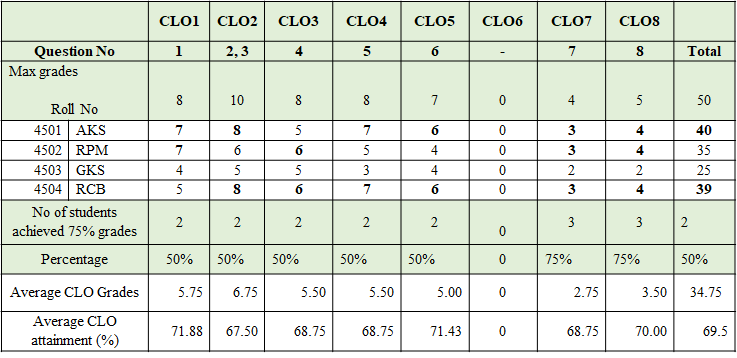
Taking a step further, Table 4 summarizes the marks scored by students in a course from all assessment methods (out of 100). The actual score of CLOs (obtained by student) from different assessment methods (quiz, assignment, midterm, final, etc.) are aggregated in order to compare with the weighted score of each CLO. Here again, data should be tabulated in an excel sheet in order to calculate the target attainment and the average CLO attainment.
Table 4: Student wise summary of attainment of CLOs in a course (out of 100)

*Target 50% students attain 75% or more
The effectiveness of teaching and learning is determined by the assessment outcomes, which is quantified in attainment of each CLO. A higher CLO attainment percentage is the evidence of a more effective teaching and learning activity. It is therefore suggested that the instructor should take up the aggregation of the assessment data from the very first assessment activity in a course, and closely monitor its progress across each assessment method. A simple use of the Excel sheet allows the instructor to calculate the CLO attainment with respect to the target.


Comments